
Graftcode Introduction
Graftcode allows you to connect frontends, mobile apps, and backend services seamlessly, removing the overhead of APIs, SDK generation, and client maintenance.
Instead of writing REST endpoints, gRPC protobufs, DTOs, or client layers, you just:
- Write any public methods.
- Install auto-generated, strongly-typed client using regular package manager command.
- Call remote methods like local dependency.
Behind the scenes, communication is handled through our Hypertube(TM) protocol, which uses native runtime integration and binary messaging. In benchmark scenarios, it processes calls up to 70% faster than traditional WebServices and significantly faster than gRPC, while typically requiring 30 to 60% less code, and keeping your business logic fully decoupled. You can read more about performance and how we measured it in Compare Performance and test it yourself using our provided example.
Note
Start with the short intro video below to see Graftcode in action:
How it Fits Your Project
Diagrams below show how Graftcode fits into standard software project and changes your current landscape:
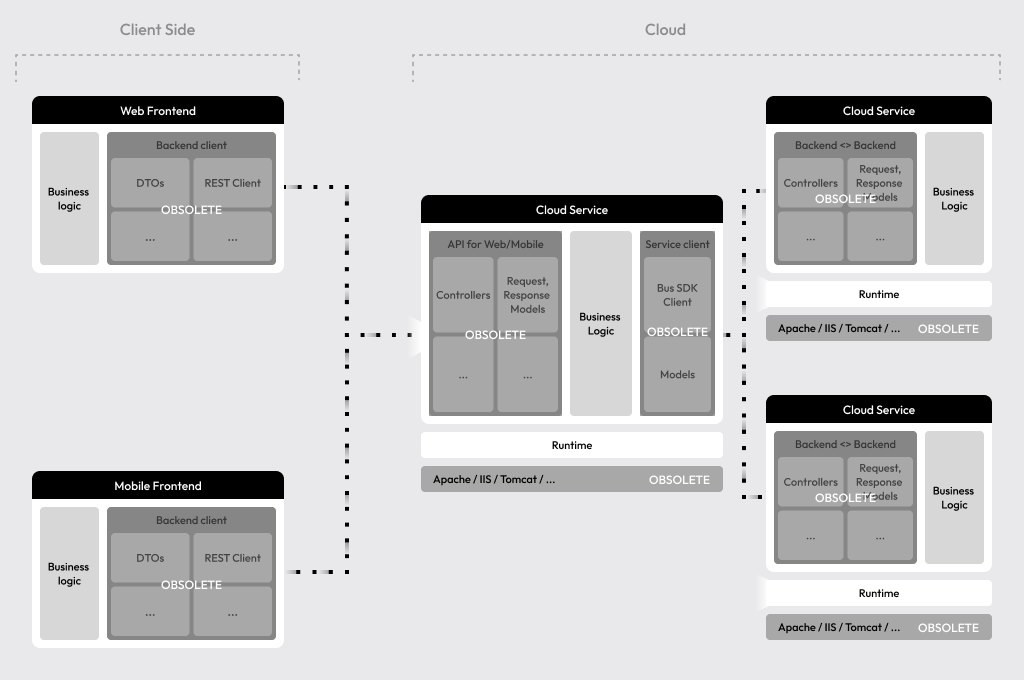
Graftcode changes the integration story from:
- implement controllers
- implement request/response DTOs
- forward calls to business logic
- implement client
- parse responses to local DTOs/models
- invoke methods on client
- monitor for changes
- keep updating each layer with each update
To:
- expose public methods on business logic or simple plain object facades
- import entire service with package manager as direct dependency (that we call Graft) - strongly-typed and always in sync client.
Now check how clean becomes your system design with Graftcode, so you can focus purely on business logic:
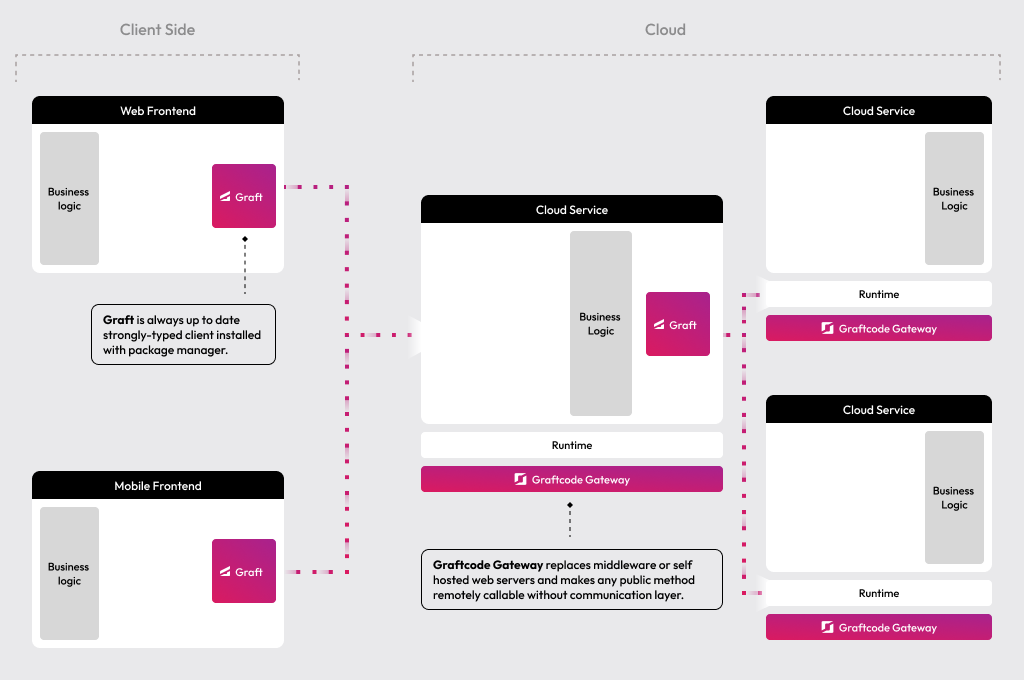
Graftcode removes need for all previosuly required communication code both on client and service side. Same approach works for frontends and between microservices in your cloud. To make any public method callable just replace your middleware (Self-hosted webservice/IIS/Tomcat/Apache) with Graftcode Gateway (our multi-runtime host).
Tip
It is not hiding REST or gRPC behind generated wrapper code. It is replacing it with direct runtime integration based on binary communication connecting directly to target runtime native-layer ensuring highest reliability and unbeatable performance.
As Graftcode works across all major programming languages runtimes both remotely as well as within single process, you can also leverage the best libraries from any ecosystem, including Python, Java, C#, Node.js, Perl, PHP, Ruby and Go, without complex interop and mix them in one app or service.
This allows you to build applications faster, decouple from integration logic, iterate quickly, and scale seamlessly even changing between monolith and microservices architectures with just configuration change.
Let's see this in action through a real-world demo.